
|
 |
|
|
|
|
|
|
|
|
||||||||
Dedicated to Building Shared Understanding of Wicked Problems
|
||||||||


Dialogue Mapping™ is a radically inclusive facilitation process that creates a diagram or 'map' that captures and connects participants' comments as a meeting conversation unfolds.
In the experts' words:
"... in Dialogue Mapping™, we are NOT attempting to corral participants to speak in "logical order"... for example, we do NOT say at any point, 'okay, for the next 15 minutes, as a facilitator I only want to hear the pluses and minuses for this particular idea, so that we can complete that section of our diagram.' INSTEAD, a participant might offer a different solution, or a minus to a previous solution, or a different question altogether.... The power of Dialogue Mapping™, in my view, is that it allows you to create a LINEAR, ORDERED display, out of a NON-LINEAR, CREATIVE process."
Rosa Zubizarreta
Author and Management Consultant
"I want to talk about the challenge of our generation. [...] Our challenge, our generation's unique challenge, is learning to live peacefully and sustainably in an extraordinarily crowded world.[...] The way of solving problems requires one fundamental change, a big one, and that is learning that the challenges of our generation are not us versus them, they are not us versus Islam, us versus the terrorists, us versus Iran, they are us, all of us together on this planet against a set of shared and increasingly urgent problems."
Jeffrey Sachs: 2007 Reith Lectures http://www.bbc.co.uk/radio4/reith2007
A Tool for Wicked Problems: Dialogue Mapping™ FAQs
|
|
|
What is Dialogue Mapping™?
Dialogue Mapping™ is a radically inclusive facilitation process that creates a diagram or 'map' that captures and connects participants' comments as a meeting conversation unfolds. It is especially effective with highly complex or “Wicked” problems that are wrought with both social and technical complexity, as well as a sometimes maddening inability to move forward in a meaningful and cost effective way.
Dialogue Mapping™ creates forward progress in situations that have been stuck; it clears the way for robust decisions that last. It is effective because it works with the non-linear way humans really think, communicate, and make decisions.
What is a Dialogue Mapping™ Session Like?
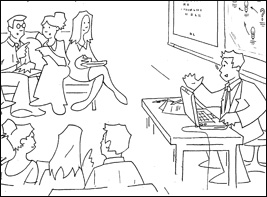
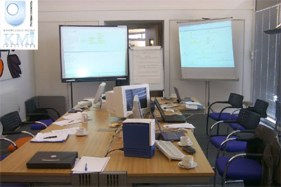
Picture a meeting room with the usual tables and chairs and with a computer, display projector, and screen. Now bring in a group of people working on a project or problem. Now bring in a facilitator (also known as a "technographer") who sits at the computer and types.
|
|
A typical Dialogue Mapping™ arrangement.
 |
A very good arrangement in a meeting room
at the Knowledge Media Institute,
Open University, UK.
 |
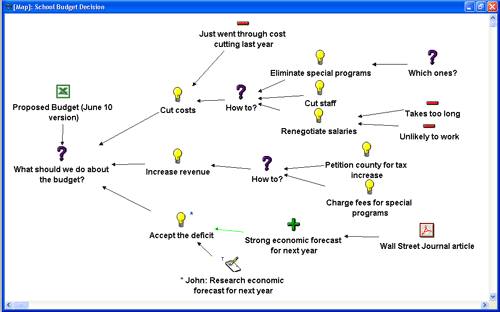
As the people in the meeting speak, the facilitator paraphrases and captures what they are saying in a hypertext diagram on the screen. For example, at one moment in the meeting the dialogue map might look like this:
|
|
 |
|
The icons represent the basic elements of the Dialogue Mapping™ grammar (called IBIS): Questions, Ideas, Pros and Cons.
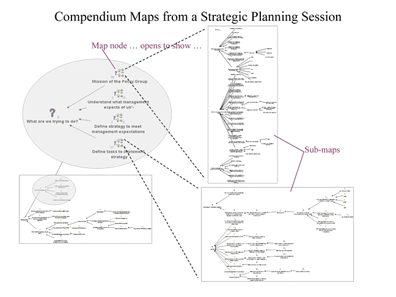
This is a very simple map, meant to convey the basics of IBIS. In real meetings and projects the maps are much larger, more complex, and can be nested deeply. Here's an example of some larger maps from a 2-day strategic planning meeting:
This combination of (i) a shared hypertext display, (ii) a trained facilitator, and (iii) a conversational grammar is Dialogue Mapping™. (For a detailed narrative of a Dialogue Mapping™ session, see "The Dialogue Mapping™ Experience".)
In Dialogue Mapping™, as the conversation unfolds and the map grows, each person can see a summary of the meeting discussion so far. The map serves as a "group memory," virtually eliminating the need for participants to repeat themselves to get their points made.
Moreover, Dialogue Mapping™ captures the way that we humans actually converse and solve problems (in a non-linear way), rather than the way most of us wish we solved problems (in a structured way). View a short YouTube demo illustrating how Dialogue Mapping™ does this. (If you have trouble viewing the YouTube site, try this version.)
Some Benefits of Dialogue Mapping™ include:
 Each participant's contribution is heard and acknowledged in the map.Each participant can see how their comments relate to others.The group sees where they are, where they've come from, and where they are going, and is thus self-correcting if they get "off-topic." (example Agenda map)The shared display map shifts the dynamic of the group into a collaborative mode ... "What can we think and learn together."The map focuses the group on a kind of "lightly logical" perspective as they work on the issues at hand.The map increases the group's shared understanding about the problem at hand, possible solutions, meaning issues, roles and responsibilities ... all of the key elements of a successful project.At the end of the meeting or during breaks, the group can view various printed snapshots of their discussion.Thanks to the IBIS grammar, the map summarizes the rationale behind any decisions that are madeSince the map captures the thinking process of the group, anyone who was not at the meeting can be quickly brought up to speed by reviewing the map with them.The map easily displays all of the open issues and action items at any point. Each participant's contribution is heard and acknowledged in the map.Each participant can see how their comments relate to others.The group sees where they are, where they've come from, and where they are going, and is thus self-correcting if they get "off-topic." (example Agenda map)The shared display map shifts the dynamic of the group into a collaborative mode ... "What can we think and learn together."The map focuses the group on a kind of "lightly logical" perspective as they work on the issues at hand.The map increases the group's shared understanding about the problem at hand, possible solutions, meaning issues, roles and responsibilities ... all of the key elements of a successful project.At the end of the meeting or during breaks, the group can view various printed snapshots of their discussion.Thanks to the IBIS grammar, the map summarizes the rationale behind any decisions that are madeSince the map captures the thinking process of the group, anyone who was not at the meeting can be quickly brought up to speed by reviewing the map with them.The map easily displays all of the open issues and action items at any point.They gain ownership in the map, and commitment to collaboratively crafting the clearest and most compelling map of their collective thinking. The art of creating this kind of ownership in the shared Dialogue Map is the subject of the Dialogue Mapping™ book.
A Key to Dialogue Mapping™: Shared Display
Project teams need to minimize fragmentation and maximize shared understanding and shared commitment in order to stop the cycle of project failures. One of the most powerful mechanisms for doing this is use of a shared display.
The appropriate use of computer display by a facilitator using Dialogue Mapping is one way to exploit the power of shared display. It allows the group to recognize the Dialogue Map as a value-adding augmentation of their meeting discussion, thus increasing coherence and increasing the likelihood of project success.
In this way, Dialogue Mapping™ is distinct from traditional facilitation.
How is Dialogue Mapping™ different from traditional facilitation?
We're all familiar with the role of the facilitator. This is the role of the neutral person who plans and guides a group through a meeting, keeping the group on schedule and on topic, and addressing process issues like one person dominating the conversation or group members getting stuck in a debate. The facilitator uses learned skills and intuition to interact with the group in ways that effectively “facilitate” their accomplishment of their meeting objectives.
Dialogue mapping has the same intention as facilitation: to help the group members hold an effective conversation on a complex topic. By “effective” we mean a conversation that both accomplished the objectives and built higher levels of shared understanding, respect, alignment, and transparency. But dialogue mapping uses two tools that are relatively new to the conference room.
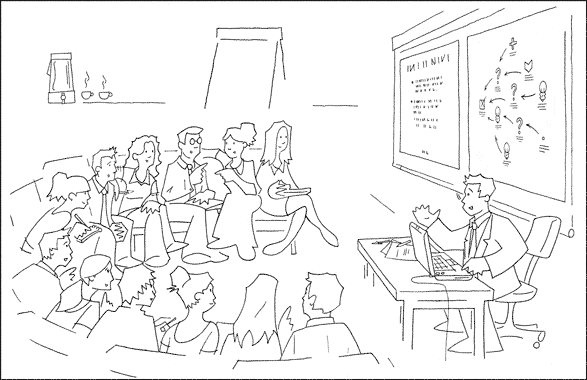 The first is to capture key elements of the conversation in a shared display. This could be whiteboards or flipcharts, but more often these days it's a computer projector. Shared display means that what is projected in the display is being crafted by the group actively. People's comments are somehow reflected in the display. We're not talking about PowerPoint here!! Sometimes referred to as interactive visual modeling, shared display requires that there be someone driving the computer who has the skills and intention of adding value to the group's interaction and creating group memory of the group's thinking and learning.
The second aspect of dialogue mapping that is new and different is the use of a simple conversational grammar called IBIS, Issue Based Information System. IBIS represents the moves in a conversation as Questions, Ideas (possible answers to the Question), and Arguments (pros and cons to the ideas). The power of IBIS is its emphasis on questions. In an IBIS diagram new questions arise to clarify assumptions, challenge arguments, shift the context, and explore the deeper implications of ideas. Dialogue mapping requires that the mapper be so fluent in IBIS that they can translate everyday meeting-speak (e.g. “Why are we talking about this?”, “That's not the issue!”, etc) on the fly into IBIS and write or type it into the shared display for the group to see and validate. The pinnacle of fluency in IBIS is being able hear the hidden questions behind participants' comments. Here is a simple IBIS map of a complex budgeting issue …
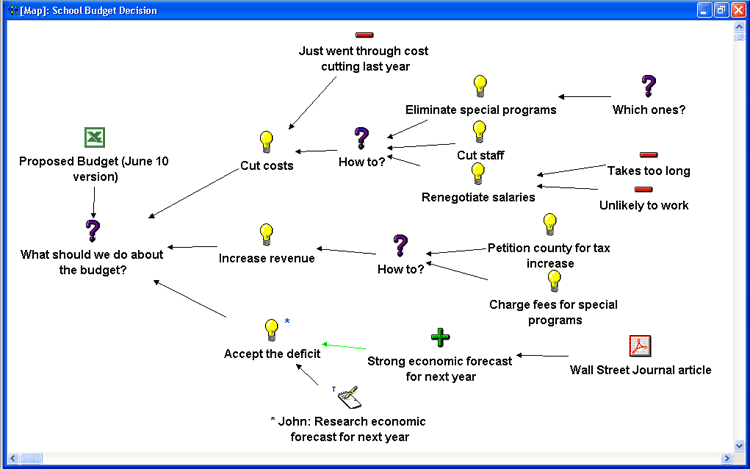 It's interesting what happens when a group has a shared dialogue map to interact with during a discussion. As each comment gets captured in the map it becomes clear that listening and understanding each point of view is important. As the conversation goes on there's very little tendency for people to repeat earlier points, and when the discussion starts to cycle someone usually points at the map and says, “I think we've already covered this issue.” Having a few explicit questions in the field of display helps to lower the fog factor and the group tends to stay on topic.
In short, many of the process functions that a facilitator would normally provide come “for free” when the group has a shared display of the key elements of the conversation. As one dialogue mapper observed, “In Dialogue Mapping, we are not attempting to corral participants to speak in `logical order'... for example, we do not say at any point, 'okay, for the next 15 minutes, as a facilitator I only want to hear the pluses and minuses for this particular idea, so that we can complete that section of our diagram.' Instead, a participant might offer a different solution, or a minus to a previous solution, or a different question altogether. The power of dialogue mapping, in my view, is that it allows you to create a linear, ordered display, out of a non-linear, creative process.”
It's still helpful to have someone to watch the clock and make sure that the coffee doesn't run out, but in a simple reflective way dialogue mapping shifts the hardest parts of facilitation to the group members themselves.
|
|


Contents of this web site and all original works are copyright © CogNexus Institute - All rights reserved. The material on this site may not be reproduced, distributed, transmitted or otherwise used, except with the prior written permission of owner.